Overview
- Discovered in 2001 in the Djurab Desert of Chad and dated to approximately 7 million years ago, Sahelanthropus tchadensis is the oldest known potential hominin, represented primarily by a near-complete cranium nicknamed 'Toumaï.'
- Its combination of a small, non-honing canine, an anteriorly positioned foramen magnum, and a mosaic of primitive and derived cranial features places it close to the divergence point of the human and chimpanzee lineages.
- The 2022 description of postcranial remains—a femur and two ulnae—ignited a vigorous scientific debate about whether Sahelanthropus was a habitual biped, with competing analyses reaching opposing conclusions through 2025.
Discovered in Chad in 2001, Sahelanthropus tchadensis ("Toumaï") dates to approximately 7 million years ago, making it the oldest known potential hominin.1, 2 Its location far west of the East African Rift Valley upended the assumption that early human evolution was confined to East Africa.1, 2
Anatomy and dating
The TM 266 fossil site in the Djurab Desert lacks volcanic ash, so researchers initially estimated its age using biochronology. Cosmogenic nuclide dating later refined this to 7.04 ± 0.18 million years ago, placing Sahelanthropus near the estimated divergence of chimpanzees and humans.6, 7, 8
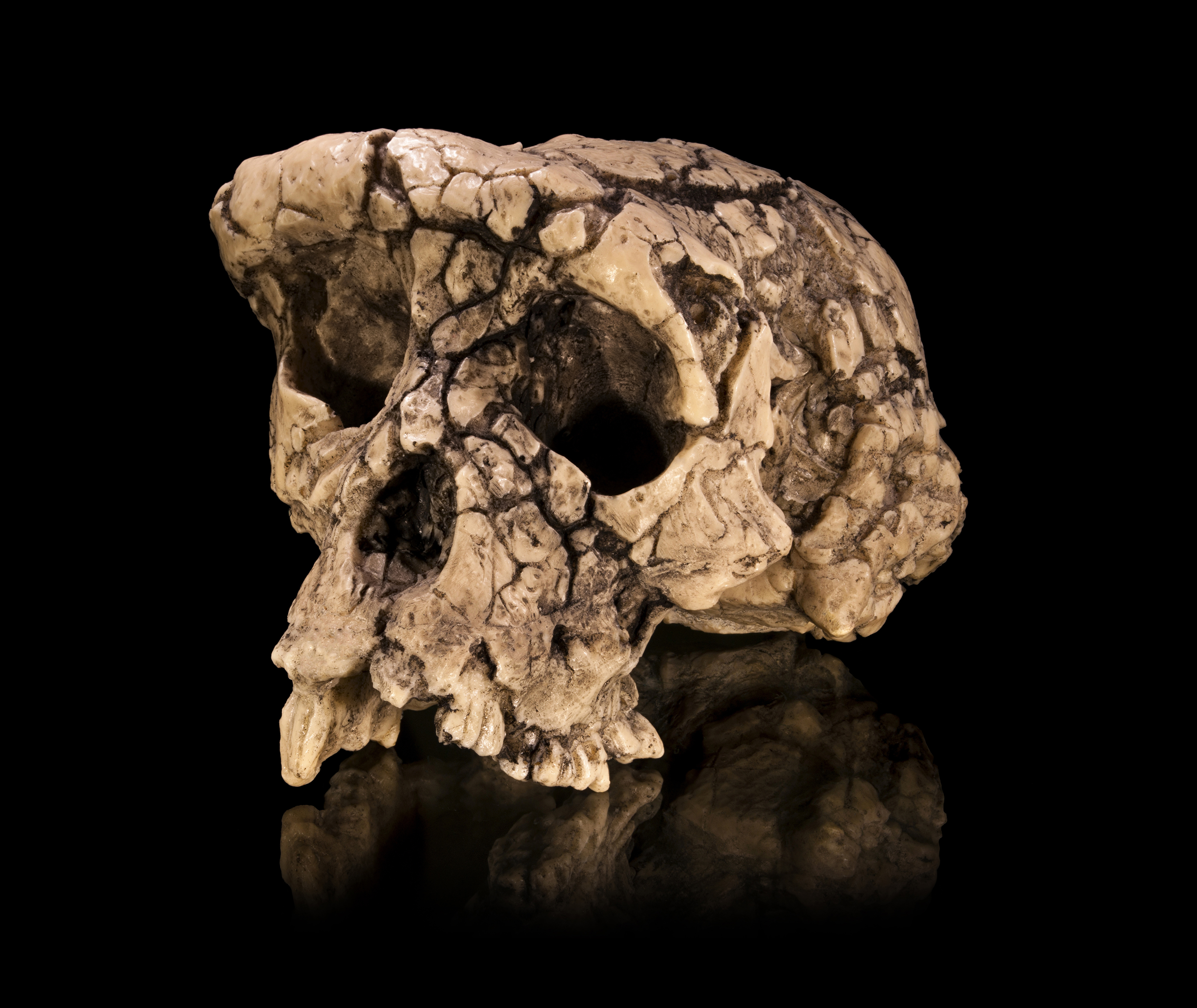
The Toumaï cranium blends primitive and derived features in a striking mosaic.1, 9 Its braincase is chimpanzee-sized (360–370 cc), with a massive, continuous brow ridge and a long, low vault.1, 10 Yet unlike any known great ape, it has a relatively flat face, small canines without a honing complex, and an anteriorly positioned foramen magnum (the skull base opening for the spinal cord).1, 5, 9
Key cranial measurements of Sahelanthropus compared with other taxa1, 9, 10
| Feature | Sahelanthropus | Chimpanzee | Australopithecus |
|---|---|---|---|
| Endocranial volume | 360–370 cc | 300–400 cc | 400–550 cc |
| Canine honing complex | Absent | Present | Absent |
| Foramen magnum position | Anterior | Posterior | Anterior |
| Supraorbital torus | Massive, continuous | Moderate | Variable |
| Facial prognathism | Reduced | Pronounced | Moderate |
Interpretation and debate
The forward placement of the foramen magnum suggested upright head carriage consistent with bipedal locomotion, leading researchers to classify Sahelanthropus as a hominin.1, 9, 10 Critics countered that the cranium's features were artifacts of fossilization distortion and that Toumaï was an ancestor of gorillas or another ape lineage.3, 4 Digital reconstructions addressed many of these concerns, though the precise phylogenetic position of Sahelanthropus remains debated.9, 11
The debate sharpened in 2022 when postcranial remains—a femur and two ulnae—were finally described. The initial analysis concluded the femur indicated habitual bipedality, while the ulnae suggested substantial tree-climbing.12 A competing team challenged this interpretation, arguing the femur's internal structure and external morphology pointed to quadrupedalism rather than hominin bipedalism.13 Subsequent 3D morphometric studies countered again, finding hallmarks of bipedal hip and knee function.14
Timeline of Sahelanthropus research milestones1, 12, 14
Evolutionary significance
Whether or not Sahelanthropus walked upright, its blend of derived and primitive traits shows that human evolution was not a uniform, linear progression.1, 9 This mosaic pattern—different anatomical features evolving at different rates—is a hallmark of early hominin evolution.16 And its geographic location in central Africa fundamentally revised models that had confined human origins to the East African Rift.15
References
Cosmogenic nuclide dating of Sahelanthropus tchadensis and Australopithecus bahrelghazali: Mio-Pliocene hominids from Chad
Generation times in wild chimpanzees and gorillas suggest earlier divergence times in great ape and human evolution
Morphological affinities of the Sahelanthropus tchadensis (Late Miocene hominid from Chad) cranium
Postcranial evidence does not support habitual bipedalism in Sahelanthropus tchadensis: A reply to Daver et al. (2022)